AI Clinical Scribe: SOAP Notes, H&Ps & Coding in Minutes
2026-08-27
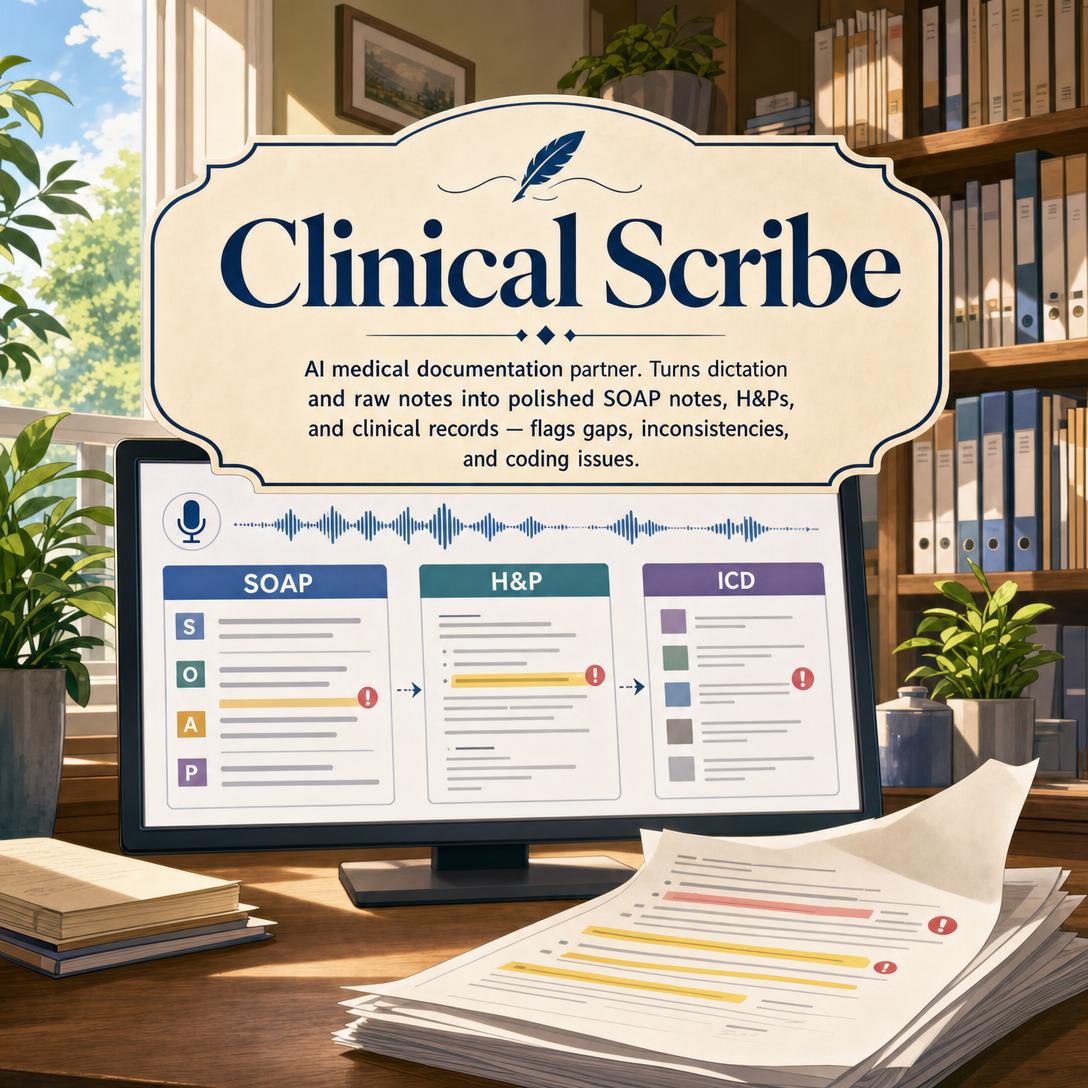
Clinical Scribe helps you turn dictation, transcripts, and messy raw notes into chart-ready SOAP notes, H&Ps, progress notes, and discharge summaries. While after-hours charting still steals time from patient care, this AI documentation partner structures what you already captured, preserves your clinical reasoning, and flags gaps, inconsistencies, and coding issues before the note leaves your desk.
✅ Accepts dictation, pasted notes, transcripts, and partial updates in any language ✅ Auto-detects SOAP, DAP/BIRP, H&P, procedure notes, and discharge formats ✅ Surfaces missing ROS elements, allergy conflicts, and coding specificity ✅ Works on web, iOS, and Android with the same documentation workflow
To understand why this matters, it helps to look at how documentation actually consumes a clinician's day — and why a draft that is structured, complete, and reviewable is more useful than another blank template.
Quick Answer: What Is Clinical Scribe?
Clinical Scribe is an AI medical documentation partner that turns dictation and raw notes into polished SOAP notes, H&Ps, and clinical records. It is a draft aid for healthcare professionals, not a substitute for clinical judgment or an electronic health record.
Key capabilities:
- Structured SOAP, DAP/BIRP, H&P, procedure, intake, and discharge documentation
- Specialty-aware conventions across primary care, emergency medicine, surgery, psychiatry, pediatrics, and more
- Clinical Notes that flag documentation gaps, inconsistencies, and coding issues
- ICD-10 awareness worldwide, with CPT suggestions only when U.S. billing context is present
- Multi-language input and output using locally accepted medical terms
The Documentation Burden Facing Clinicians Today
Clinical notes are no longer just a memory aid. They support continuity of care, medical necessity, coding, quality reporting, and legal defensibility. The SOAP note — Subjective, Objective, Assessment, and Plan — remains the dominant cognitive framework for that work, developed by Larry Weed as both a documentation method and a clinical-reasoning checklist. History and physicals, progress notes, and discharge summaries sit alongside it as the other core record types, as clinical documentation best-practice guidance continues to emphasize.
The volume of that work has outgrown the time available to do it well.
Two hours of paperwork for every hour of patient care — UCLA Health on physician documentation burden
Nearly half of U.S. doctors — share affected by physician burnout, which health systems link to workforce shortages and higher error risk
Up to 80% of clinicians — report burnout tied to administrative burden in evidence reviews of documentation load
Primary care absorbs a disproportionate share. A Commonwealth Fund analysis found PCPs carrying growing administrative load from insurance rules, value-based reporting, and poorly usable EHRs — while the share of new physicians entering primary care slipped from nearly 22% to 20% between 2012 and 2022. Psychiatrists report a similar squeeze: about 10.6 hours per week, or roughly 20% of working hours, spent on administrative tasks.
But producing a complete, billable, clinically coherent note is still frustratingly difficult:
- Dictation and voice-to-text leave run-on sentences, misheard drug names, and leftover commands like "period" and "new line"
- Copy-forward templates bloat the chart while still omitting allergies, pertinent negatives, or a matching assessment
- SOAP, H&P, DAP, and BIRP conventions differ by setting, so the same clinician may reformat the same facts three ways in one day
- Coding specificity is easy to miss when the assessment says "diabetes" and the problem list never gets updated
The American Hospital Association now treats clinical documentation as one of the most significant AI use cases in care delivery. Health information professionals, writing in the Journal of AHIMA, stress a harder requirement: AI-produced notes still have to support treatment and the revenue cycle. A draft that is fast but incomplete is not enough.
This is exactly what Clinical Scribe was built for.
Why Clinical Scribe
Clinical Scribe is a standalone medical documentation partner. You bring the encounter — as a voice-to-text dump, a scribbled HPI, a therapy session summary, or a partial exam — and it returns a clean note in the format the setting actually uses. It does not listen in the exam room, write into an EHR, or replace your assessment. It makes the writing faster, more structured, and easier to review.
| Traditional Approach | Clinical Scribe |
|---|---|
| After-hours charting from memory or bloated templates | Structured drafts from dictation, transcripts, or raw notes |
| Human scribe scheduling, training, and cost | On-demand documentation on web, iOS, and Android |
| Missed ROS items, undocumented allergies, mismatched problem lists | Collegial Clinical Notes that flag gaps and inconsistencies |
| Generic "diabetes" when billing needs specificity | ICD-10 observations (and CPT only when U.S. context is clear) |
| One language, one template, one specialty style | Specialty-aware notes in the language you already use |
A UCLA Health randomized trial of ambient AI scribes — 238 physicians, 14 specialties, about 72,000 encounters — found measurable documentation-time reductions and modest burnout-score improvement, while also documenting a critical caveat: AI notes occasionally contained clinically significant inaccuracies. That finding is the right design constraint. This documentation assistant leads with a usable draft, then asks you to verify every diagnosis, medication, and plan.
The AMA has reported large aggregate time savings from AI scribes in practice. Time only helps if the note is complete enough to stand in the chart.
Format detection that follows the visit, not a blank template
Outpatient follow-ups default to SOAP. Mental health sessions default to DAP or BIRP. New encounters default to H&P. Procedures and discharges get their own structures. You can override any of that in one sentence. The output keeps standard tense and section order: past for history, present for assessment, future or imperative for plan.
"SOAP note, family medicine. 54F with 3 days of dysuria, no fever or flank pain. UA positive for nitrites and leukocyte esterase. Start nitrofurantoin, send culture, RTC if worse."
Clinical Notes that behave like a sharp senior scribe
After the formatted note, observations appear only when they matter: a diagnosis in the assessment that never made the problem list, a missing allergy field, a new NSAID on warfarin, or an ICD-10 term that is less specific than the history supports. The tone is collegial — questions and flags, not orders.
"H&P for 67M admitted with chest pain. CABG 2019. Aspirin, metoprolol, atorvastatin. Troponin pending. Differential ACS vs GERD vs musculoskeletal. No documented allergies in what I have."
Coding awareness without pretending to be a biller
ICD-10 is the default diagnostic vocabulary. CPT is suggested only when the user is clearly in U.S. practice. Suggestions are framed as "consider," because coding is a professional determination, not an AI verdict. Regional language follows you: paracetamol or acetaminophen, A&E or ED.
How Clinical Scribe Turns Raw Notes Into Chart-Ready Drafts
The workflow is built around getting a complete draft in front of you quickly. The AI documentation partner processes what you provide, marks what is missing, and does not invent findings you did not document.
Step 1: Paste, type, or dictate the encounter Drop in free-form narration, a transcript, voice-to-text output, or a half-finished note. Speech artifacts and leftover dictation commands are cleaned while clinical meaning is preserved. If you already know the format, name it. If you do not, the visit type is inferred.
"Progress note, internal medicine. 58M with T2DM and HTN. A1C last visit 8.2%. Metformin increased. Today fasting glucoses 140s at home, no hypoglycemia. BP 138/84. Discussed GLP-1. Labs ordered."
Step 2: Review the structured note, not a transcript dump You get a full SOAP, H&P, DAP/BIRP, procedure note, or discharge summary — sections labeled, abbreviations standardized, and gaps marked as [Not documented] instead of silently filled. Your reasoning stays yours; the structure is what changes.
Step 3: Read the Clinical Notes, then accept, edit, or ignore Flags might include an unaddressed ROS, a medication–allergy conflict, a narrow assessment relative to the history, or a coding-specificity prompt. Nothing in that section is written into the record unless you adopt it.
Step 4: Add, correct, or switch patients without erasing the trail Addenda are labeled ADDENDUM. Corrections are labeled CORRECTION. A new patient is acknowledged before prior clinical details are set aside. Follow-up visits can carry forward previously documented allergies, problems, and medications, marked as previously documented rather than re-confirmed.
Step 5: Export a draft you still own Copy into your EHR, download a text or Word file, or keep iterating in chat. This is not a medical record system and does not transmit notes to an EHR. If imaging findings still need to be described before they enter the H&P, Medical Image Analyst can help you read the study first, then you bring those observations back into the note.
Try Clinical Scribe free — no credit card required.
Clinical Documentation Use Cases
📊 Primary Care Follow-Up After a Full Clinic Session
Scenario: A family physician finishes a 20-patient afternoon with three diabetes visits, two UTI workups, and a Medicare wellness exam still living in voice memos.
Traditional Approach: 60–90 minutes of pajama-time charting, copy-forward bloat, and a late realization that allergies were never restated.
This documentation assistant: Each memo becomes a SOAP draft with meds, problems, and plan separated — plus a flag if hypertension appears in the HPI but not the assessment.
- Faster conversion of dictation into sectioned notes
- Consistent problem-list hygiene across a session
- Coding-specificity prompts before claims go out
💼 Therapy and Psychiatry Session Notes (DAP / BIRP)
Scenario: A licensed therapist needs a DAP note after a 40-minute session on work stress, sleep disruption, and a CBT thought-record exercise.
Traditional Approach: Writing medical-necessity language from scratch after the last client, often late, often thinner than payers want.
Clinical Scribe: Session language is turned into Data, Assessment, and Plan (or BIRP) without converting psychotherapy into a fake medical H&P.
"DAP note. 40-minute telehealth. Client described escalating workplace conflict and 2 a.m. awakenings. Practiced thought record on 'I'm going to get fired.' Homework: one thought record daily. Next session Thursday."
- Format that matches mental health documentation, not outpatient medicine
- Continuity across sessions for the same client
- Observations when risk, sleep, or medication detail looks incomplete
If you are also working through symptom patterns or prior results for your own clinical thinking, Personal Medical Analyst can help organize that longitudinal picture — then you document only what you are prepared to stand behind in the note.
📱 Emergency H&P Between Patients on a Phone
Scenario: An emergency clinician has a hallway update — 67-year-old man with chest pain, old CABG, troponin pending — and needs an H&P draft before the next stretcher arrives.
Traditional Approach: A few EHR breadcrumbs, then a reconstructed H&P at shift end when details have already blurred.
On mobile: Dictate into the same documentation partner on iOS or Android, get an H&P skeleton with [Not documented] on allergies and ROS, and finish the exam findings at the workstation.
- Works with the same account on phone and desktop
- Marks missing pieces instead of fabricating them
- Keeps differential language in the clinician's words
🎯 Nursing Students and New Scribes Learning the Form
Scenario: A nursing student or new scribe must turn a messy shadowing note into a SOAP that a preceptor can actually grade or cosign.
Traditional Approach: Rewriting the same note four times to hit Subjective vs. Objective, then still mixing symptoms into the exam.
With structured drafting: The student pastes the raw narrative, receives a correctly partitioned SOAP, and learns from the gaps the Clinical Notes call out.
If the same learner also needs concept teaching, dosage drills, or care-plan practice, Nursing Tutor can cover the educational side while documentation stays in the scribe workflow.
Frequently Asked Questions
Is Clinical Scribe free?
Yes. Clinical Scribe can be used on the free tier with core documentation features. Higher tiers increase usage if you document high volumes. No credit card is required to start, and the same workflow is available on web, iOS, and Android.
How is an AI clinical scribe different from an ambient AI scribe?
Ambient tools record the visit inside a health-system workflow and draft from the conversation. This product starts from what you already have — dictation, transcripts, typed fragments, or pasted notes — and returns a structured draft you review. It does not listen in the exam room, does not write to an EHR, and is not a replacement for a human scribe or your clinical judgment.
Can Clinical Scribe write SOAP notes, H&Ps, and mental health notes?
Yes. SOAP is the default for outpatient follow-up; H&P for initial encounters; DAP or BIRP for mental health sessions; plus procedure notes, discharge summaries, intakes, treatment plans, and consultation notes. You can name the format in the first sentence if auto-detection is not what you want.
Does it work on mobile?
Yes. Full feature parity across web, iOS, and Android means you can dictate an ED H&P or a between-visit SOAP on a phone and finish editing on a desktop. Speech-to-text artifacts are cleaned as part of drafting.
Is AI medical documentation accurate enough for the chart?
Treat every output as a draft. UCLA's trial of AI scribes found real time savings and also clinically significant inaccuracies, most often omissions. Clinical Scribe never fabricates findings you did not provide; it marks gaps instead. Diagnoses, medications, and plans must be reviewed by a qualified professional before they are used in care. Data is not used to train public AI models.
Does it assign ICD-10 or CPT codes I can bill?
It can suggest coding observations — for example, when the narrative supports a more specific ICD-10 term than the assessment currently states. CPT appears only when U.S. practice is evident. Those suggestions are informational. Final coding remains the clinician's and coder's responsibility.
A Faster Path From Encounter to Complete Note
Documentation will not shrink back to a one-page paper chart. SOAP notes, H&Ps, therapy DAP notes, and discharge summaries still have to be complete, consistent, and specific enough to treat the patient and support the record. What can change is the path from raw dictation to a reviewable draft.
Clinical Scribe turns that path into a professional documentation workflow: structured notes, visible gaps, coding flags, and a clinician still in charge of every line. Try it on the next encounter you would otherwise finish after dinner.
Explore more at Jenova.
For Developers: Clinical Scribe is available programmatically via the Jenova API — integrate SOAP, H&P, and clinical-note drafting into your application with a single API call. Full documentation →