Free AI for Resume Screening: Score Candidates, Detect Red Flags & Build Shortlists in Minutes
2026-03-30
Looking for a free AI for resume screening that actually reads resumes the way an experienced recruiter would — not just matching keywords? AI Resume Screener has already helped over 22,000 hiring managers, HR professionals, and startup founders evaluate candidates faster and more consistently. Among them, more than 6,800 users report reducing their screening time by 70% or more, and over 4,200 first-time hirers say the tool gave them the structured evaluation framework they didn't know they needed.
✅ Deep job description analysis with automatic criteria inference ✅ Per-candidate fit scores, strengths, concerns, and recommended next steps ✅ Red flag detection — gaps, inconsistencies, inflation, and cover letter cross-referencing ✅ Free to start — no credit card, no onboarding, no software installation
With 87% of companies now using AI in at least one part of their recruiting process and AI usage in recruiting doubling from 26% to 53% in a single year, the question is no longer whether to use AI for resume screening — it's whether you can afford not to. Here's why a free AI for resume screening has become essential for hiring teams of every size.
Quick Answer: What Is AI Resume Screener?
AI Resume Screener is a free-to-start AI agent that analyzes your job description, evaluates uploaded resumes and cover letters against role requirements, and delivers scored, ranked candidate assessments with actionable insights — in minutes instead of hours.
Unlike keyword-matching ATS systems that reject qualified candidates for using different terminology, it reads and interprets candidate materials the way a senior recruiter would — understanding career trajectories, assessing skill relevance contextually, and identifying both red flags and hidden potential.
Key capabilities:
- Analyzes and anchors job descriptions as persistent reference documents for consistent evaluation
- Scores candidates on a 10-point fit scale with detailed strengths, concerns, and recommended next steps
- Detects employment gaps, resume-cover letter inconsistencies, inflated claims, and overqualification signals
- Supports the full post-screening workflow: tailored interview questions, rejection emails, and reference check guidance
Why Hiring Teams Need a Free AI for Resume Screening in 2026
The hiring landscape in 2026 is defined by a paradox that manual screening cannot resolve: application volumes are surging while the quality of signal in each application is degrading. The data from the past year tells a story that should concern every recruiter, HR professional, and hiring manager.
- Application volumes have exploded — LinkedIn now sees 11,000 applications submitted every minute, a 45% surge from the prior year
- AI-generated resumes are flooding the pipeline — 40–80% of applicants now use AI to draft resumes, cover letters, and even interview responses, making applications polished but interchangeable
- The resume itself is losing value — Criteria Corp's 2026 Candidate Experience Report found that 68% of job seekers are willing to ditch the resume entirely in favor of assessments and structured interviews
- Screening accuracy collapses under volume — Human screening accuracy starts at ~80% for the first 20 resumes but drops to 60% after 100+ due to fatigue
- Initial screening is already 95% automated at leading organizations — PrincePerelson & Associates reports that professional recruiters in 2026 are freed from resume-screening minutiae to focus on relationship building and strategy
⏱️ The Time Drain Is Unsustainable
23 hours — average time spent screening resumes for a single hire Source: Testlify
Recruiters spend 6–8 seconds on an initial resume scan, but meaningful evaluation takes 3–5 minutes per resume. For a role with 250+ applicants — the average for corporate job postings — that's over 12 hours of first-pass screening before a single interview is scheduled. Multiply across multiple open positions, and recruiting teams spend more time reading resumes than actually talking to candidates.
🤖 The AI Arms Race Has Changed the Game
The most significant shift in 2026 isn't that employers are using AI — it's that candidates are too. When 79% of job seekers use AI in their applications, every resume becomes optimized for the same keywords, formatted to the same standards, and polished to the same sheen. As DISHER Talent Solutions reports, "employers get polished but interchangeable profiles, and AI-based matching becomes less useful because surface alignment no longer reflects real fit."
The result: 64% of recruiters report seeing more look-alike applications, and 19% of organizations using AI in hiring report their tools have overlooked qualified applicants. Simple keyword matching isn't enough anymore. You need AI that reads for meaning, context, and trajectory.
💰 The Cost of Slow Screening
Top candidates are available for roughly 10 days before accepting other offers. The average time-to-hire has grown to approximately 42–44 days.
Every day a position remains unfilled costs organizations an estimated $500 in lost productivity. Slow screening doesn't just waste recruiter time — it directly translates to lost talent and lost revenue. A free AI for resume screening eliminates the bottleneck between receiving applications and identifying who deserves a conversation.
What Makes AI Resume Screener Different from an ATS
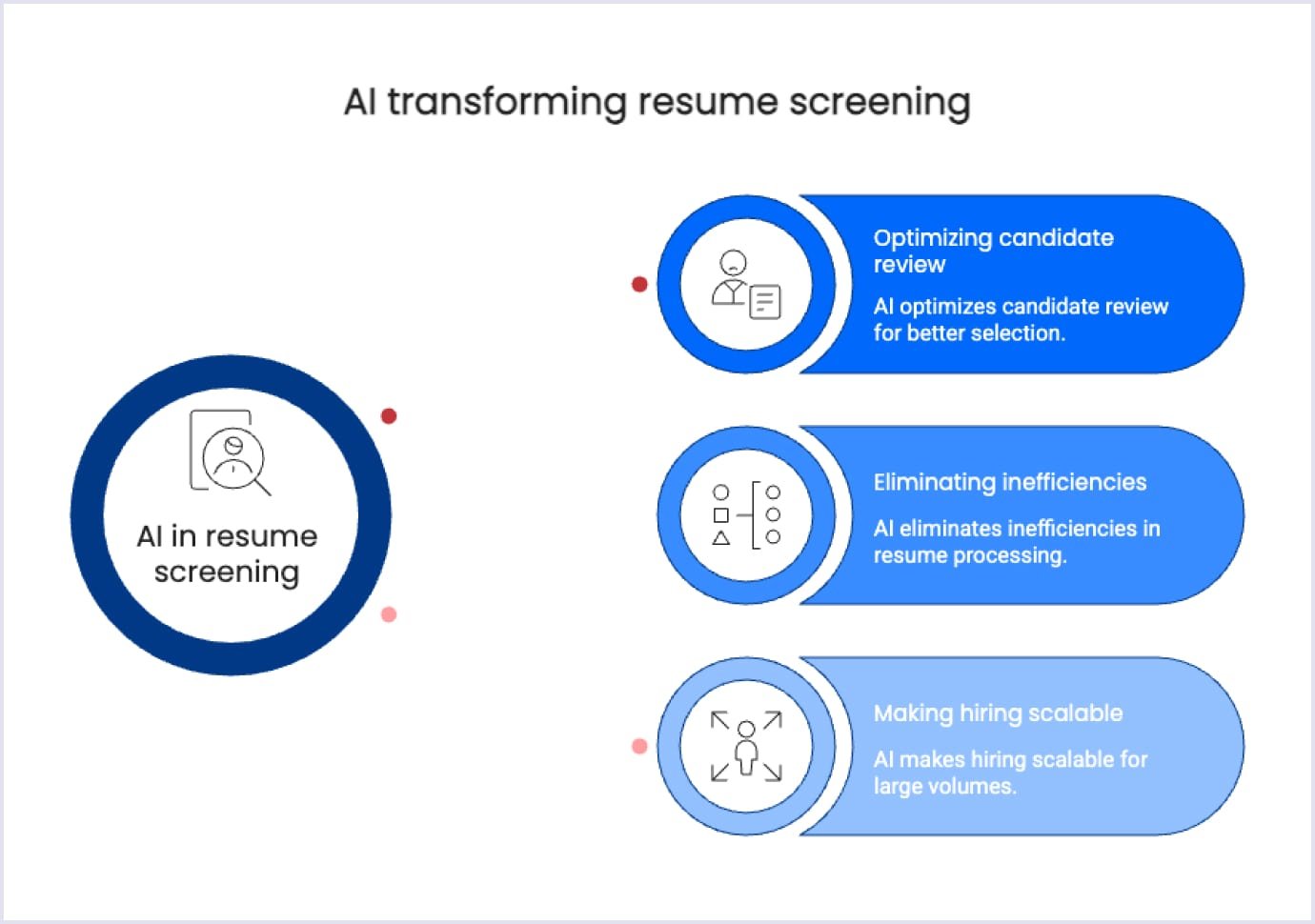
Most hiring teams already have an Applicant Tracking System. But traditional ATS platforms use rules-based keyword filters that miss context, penalize non-standard terminology, and treat every resume as a checklist rather than a narrative. AI Resume Screener operates fundamentally differently — it reads and interprets resumes the way an experienced senior recruiter would.
| Traditional ATS / Keyword Screening | AI Resume Screener |
|---|---|
| Rejects "project management" if the JD says "program management" | Understands semantic equivalence and skill adjacencies |
| Scores based on keyword density | Evaluates career trajectory, skill relevance, and accomplishment quality |
| Binary pass/fail with no explanation | Structured verdict (Strong Yes / Yes / Maybe / No) with detailed reasoning |
| No red flag detection beyond gaps | Active identification of inconsistencies, inflation, overqualification, and cover letter mismatches |
| Screening only — no post-screening support | Interview questions, rejection emails, and reference check guidance built in |
| Requires expensive enterprise licenses | Free to start with no setup required |
🎯 Contextual Understanding, Not Keyword Counting
Resume Screener deeply analyzes your job description to understand what the role actually requires — not just what keywords appear. If your JD is vague or incomplete, it probes for clarity before screening begins. It stores the JD as a persistent reference document, loading it before every evaluation to prevent drift across long screening sessions.
This matters because automated systems achieve accuracy rates of approximately 95% compared to 70% for manual review — but only when they understand context, not just keywords. In a world where only 37% of employers consider credentials and learning history reliable indicators of capability, contextual assessment is the difference between finding the right candidate and filtering them out.
📊 Structured, Actionable Output
Every candidate receives a structured assessment:
- Verdict: Strong Yes / Yes / Maybe / No
- Fit Score: X/10 against role requirements
- Key Strengths: 2–3 specific bullets
- Concerns/Gaps: 2–3 specific bullets
- Standout Notes: Red flags, hidden gem signals, cover letter quality
- Recommended Next Step: Advance to interview / Request more info / Pass
When multiple candidates are reviewed, the tool generates comparison tables for quick side-by-side evaluation — exactly the kind of scannable output busy hiring managers need.
🔍 Red Flag Detection That Goes Beyond Gaps
The agent actively identifies:
- Unexplained employment gaps
- Inconsistencies between resume and cover letter claims
- Job-hopping patterns without clear career progression
- Inflated or vague accomplishment statements
- Generic cover letters that don't address the specific role
- Overqualification signals that suggest flight risk
💎 Hidden Gem Identification
Beyond checkbox matching, this AI looks for candidates who don't tick every box but show exceptional potential — strong upward trajectories, transferable skills from adjacent industries, or demonstrated results that outweigh credential gaps. These candidates are explicitly flagged so they aren't overlooked in a stack of AI-polished, visually identical applications.
How It Works: From Job Description to Ranked Shortlist
Step 1: Share Your Job Description
Paste the job description directly into the chat or upload it as a document. AI Resume Screener analyzes the role requirements, infers evaluation criteria, and saves the JD as a persistent reference for the entire session.
"Here's the JD for our Senior Product Manager role. We're especially looking for candidates with B2B SaaS experience and strong cross-functional leadership."
Step 2: Upload Candidate Resumes
Upload up to 10 files per message. For larger candidate pools, send resumes across multiple messages — or consolidate multiple resumes into a single file. The agent can hold off on screening until you signal that all candidates have been uploaded, or process them incrementally if you prefer real-time feedback.
"I have 30 resumes to review. I'll send them in batches of 10. Don't start screening until I say I'm done uploading."
Step 3: Receive Structured Assessments
AI Resume Screener loads the JD reference and each candidate's file, then delivers detailed per-candidate evaluations with fit scores, strengths, concerns, and recommended next steps. A comparison table summarizes all candidates at a glance.
Step 4: Dive Deeper or Move Forward
Ask for expanded analysis on any candidate, request tailored interview questions for specific gaps, or have the agent draft rejection or advancement emails. You can also add new candidates at any point — the agent integrates them into the existing roster and updates rankings.
"Give me deeper analysis on Candidate #5 and draft interview questions focused on their leadership experience gap."
Step 5: Export and Share
Download screening reports as PDF, Word, or CSV for team sharing. The agent maintains full session context — client details, standards, and work completed — so every subsequent response builds on what came before.
How 22,000+ Hiring Teams Are Using AI Resume Screener
📊 High-Volume Seasonal Hiring
Scenario: A hospitality chain hiring 80 seasonal staff across four locations receives 1,500+ applications in two weeks.
The old way: Two HR coordinators spend 3+ weeks on initial screening, losing top candidates to faster-moving competitors. Inter-rater reliability sits at just 60–70% — meaning the two reviewers disagree on 30–40% of candidates.
With AI Resume Screener: Upload batches of resumes organized by location, receive scored shortlists same-day. Comparison tables make it easy to identify top candidates across all four sites. Rejection emails drafted and ready to send.
- ✅ Screening time reduced from weeks to hours
- ✅ Consistent evaluation eliminates reviewer fatigue and disagreement
- ✅ Hidden gem candidates surfaced from non-traditional backgrounds
- ✅ Every applicant gets a response — no ghosting
💼 Startup Founder Making Their First Critical Hire
Scenario: A seed-stage founder with no recruiting experience needs to hire a lead engineer. They've posted the role on three job boards and received 90 applications — and have no idea how to evaluate the trade-offs between candidates with different tech stacks, experience levels, and career trajectories.
The old way: The founder spends 20+ hours reading resumes, Googling unfamiliar technologies, and second-guessing every decision. They end up interviewing 12 candidates because they can't narrow the field confidently.
With this AI: The agent helps the founder clarify what they're actually looking for, screens all 90 resumes against the refined criteria, and provides a ranked shortlist with plain-language explanations of why each candidate fits or doesn't. It then generates tailored interview questions for the top 5.
- ✅ First-time hirers get recruiter-level guidance without recruiter-level cost
- ✅ Evaluation criteria adapted to the specific role, stage, and context
- ✅ Post-screening support reduces the founder's workload further
- ✅ Confidence in shortlist decisions backed by structured reasoning
📱 Recruiting on the Go
Scenario: An HR director traveling for a conference needs to review a batch of candidate resumes before a hiring committee meeting the next morning. She's on her phone in a hotel lobby.
The old way: Downloading and reading each resume on a phone screen, trying to take notes in a separate app, and hoping she remembers who stood out by morning.
With AI Resume Screener: Upload the files from mobile, receive structured assessments with comparison tables, and download the screening report as a PDF to share with the committee before breakfast.
- ✅ Full-featured screening from any device — web, iOS, and Android
- ✅ Exportable reports (PDF, Word, CSV) for team sharing
- ✅ Consistent quality regardless of when or where you review
🎯 Internal Mobility and Promotion Decisions
Scenario: An HR business partner needs to evaluate 15 internal candidates for a newly created director-level role. Each candidate has a different tenure, skill set, and career trajectory within the organization.
With the tool: Upload internal resumes and the role description. The agent evaluates each candidate's trajectory, identifies transferable skills, flags gaps that would need development support, and ranks candidates by fit — providing the structured framework the promotion committee needs for a fair, defensible decision.
- ✅ Consistent evaluation criteria applied to every internal candidate
- ✅ Development gap analysis for each candidate
- ✅ Structured output that supports transparent promotion decisions
Frequently Asked Questions
Is AI Resume Screener really free?
Yes. You can start screening resumes on AI Resume Screener with a free Jenova account — no credit card required. The free tier includes enough usage to screen a batch of candidates, review a job description, and generate interview questions. For heavier use — such as screening hundreds of candidates weekly across multiple roles — paid plans starting at $20/month provide significantly more capacity, custom model selection, and no watermarks on exported documents.
How is a free AI for resume screening different from my ATS?
Traditional Applicant Tracking Systems use keyword matching and rules-based filters that miss context and nuance. AI Resume Screener reads and interprets resumes the way an experienced recruiter would — understanding career trajectories, assessing skill relevance contextually, cross-referencing cover letters, and identifying both red flags and hidden potential that keyword systems miss entirely. It's designed to complement your ATS, not replace it.
Can it handle resumes in different languages?
Yes. The agent is language-agnostic and can evaluate resumes regardless of the language they're written in. If candidate materials arrive in a language that's unexpected for the role and location, it flags this as a potential concern and asks whether the language mismatch is relevant.
How many resumes can I screen in one session?
There's no hard limit on the number of candidates per session. You can upload up to 10 files per message and send as many messages as needed. For very large batches (50+ resumes), the agent can advise you on the most efficient upload approach, including consolidating multiple resumes into single files.
Does it work for specialized or executive roles?
Absolutely. The agent adapts its evaluation depth and criteria based on the role. For technical roles, it focuses on specific skill requirements and project experience. For executive positions, it evaluates leadership trajectory, strategic accomplishments, and organizational fit. Screening depth increases for borderline cases and highly specialized positions.
Is my candidate data kept private?
All application materials are treated as confidential. Conversations and data are never used to train public AI models and are not shared with advertisers.
The Hiring Teams That Screen Faster Win the Best Candidates
The 2026 hiring landscape is defined by a simple truth: 89% of HR professionals using AI say it meaningfully saves time or boosts efficiency, and teams using AI screening report up to 40% faster time-to-shortlist for volume roles. Meanwhile, 52% of talent leaders plan to integrate autonomous AI agents into their recruiting teams this year. The organizations that screen faster and more accurately will secure the best candidates before slower competitors even finish reading resumes.
AI Resume Screener transforms resume screening from a bottleneck into a competitive advantage — giving you structured, consistent, expert-level candidate evaluations in minutes instead of hours. Whether you're an HR professional managing dozens of open positions, a founder making your first hire, or a hiring manager drowning in AI-polished applications that all look the same, it brings the judgment of a senior recruiter to every application you receive.
The best part? It's free to start. Get started with AI Resume Screener and stop losing top candidates to slow screening processes.