Learn German Through Roleplay: AI Immersion for Real Fluency
2026-08-27
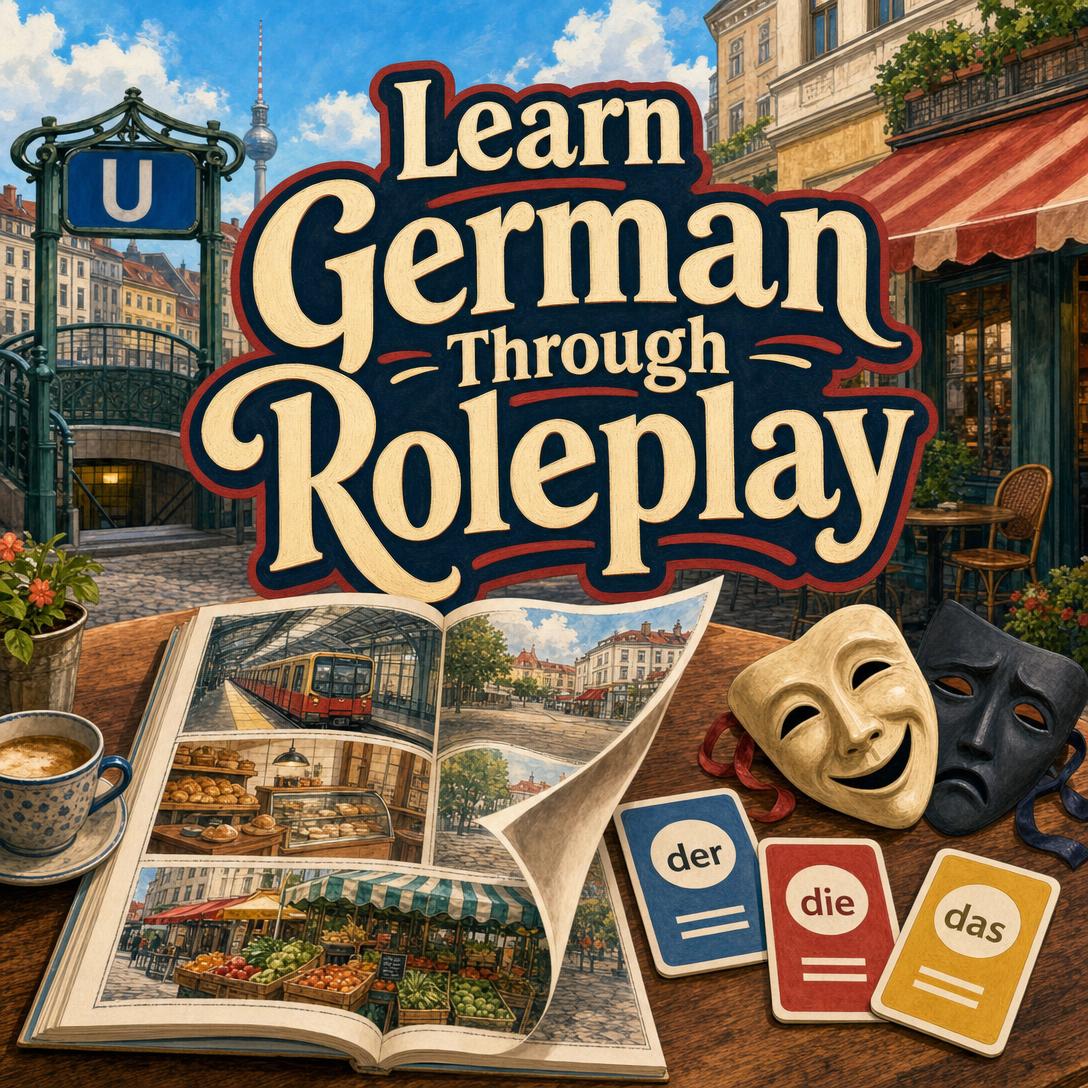
Learn German Through Roleplay helps you absorb German by living inside the language — not by stacking flashcards. While most learners stall on der/die/das, four cases, and the jump from textbook sentences to real speech, this AI tutor weaves vocabulary, grammar, and register into stories you actually care about.
✅ Adaptive scaffolding from A1 beginner through C2 advanced ✅ Gender, cases, and word order taught in context — not as isolated drills ✅ Native-sounding NPC dialogue with pronunciation support and translations that fade as you improve ✅ Teacher mode for explicit grammar, plus full immersion when you are ready to play
You participate in your own language. German arrives through the scene: a Kellner taking your order, a WG-Casting in Vienna, a tense conversation at the Amt. Words stick because they are attached to people, places, and consequences.
To understand why that matters, it helps to look at what usually blocks German learners — and why conversation-first practice is so hard to get.
Quick Answer: What Is Learn German Through Roleplay?
Learn German Through Roleplay is an AI German tutor that teaches vocabulary, grammar, and natural speech through immersive story-based roleplay at every CEFR level. You choose the setting; the tutor builds a living German-speaking world around it.
Key capabilities:
- Two modes: Lehrer-Modus for assessment, planning, and explicit teaching; Roleplay Mode for immersive scenes
- Level-aware German density, from fully translated A1 lines to near-native C1–C2 speech
- Every new noun introduced with its article (der/die/das) so gender is learned with the word
- Spoken German modeled with du/Sie, modal particles, and authentic register shifts
- Language Notes after each scene explaining the grammar and culture that dialogue alone cannot show
Why German Learners Get Stuck
German remains a major world language. More than 15.5 million people are learning it worldwide, and a German Foreign Office survey puts the figure above 15 million. Inside the EU, German is still a core school language:
19.3% — Share of EU upper secondary pupils learning German as a foreign language in 2024
The motivation is practical. Germany continues to draw international students — their share of tertiary enrolment rose from 7.1% in 2013 to 12.7% — and German opens work, study, and travel across Germany, Austria, and Switzerland. But accessing fluent, low-pressure practice is frustratingly difficult:
- Gender feels arbitrary. Nouns split into der, die, and das, and the assignment often looks random to English speakers. Research finds that learners from genderless first-language backgrounds are significantly slower to acquire accurate German gender.
- Four cases reshape every article and adjective. Nominativ, Akkusativ, Dativ, and Genitiv change der to den, dem, or des depending on the noun’s role in the sentence. For most learners, grammatical cases and noun genders are the hardest parts of German and need months of exposure to internalize.
- Word order moves the verb. In weil and dass clauses the conjugated verb jumps to the end. Separable verbs split. Beginners who only memorize present-tense statements are unprepared for real speech.
- Register is a social skill, not a grammar footnote. Using du with a Beamter or Sie with a new classmate is not a vocabulary error — it is a social one. Flashcard apps almost never teach that distinction in a living conversation.
Classroom hours are scarce. Tandem partners are inconsistent. Many apps optimize for daily streaks, not for the moment you have to decline an invitation, argue a grade, or ask where the Straßenbahn stops.
This is exactly what Learn German Through Roleplay was built for.
How It Works
The tutor runs on a simple loop: assess where you are, drop you into a story calibrated to that level, and teach through the scene. A 2025 meta-analysis of 46 studies found AI has a medium-to-large positive effect on language learning (g = 0.74). Industry data also shows over 60% of leading online language platforms now use AI-driven adaptive learning. The difference here is that adaptation happens inside a narrative, not a quiz queue.
Step 1: Establish Your Level
In Lehrer-Modus, the tutor asks about classes, media you already watch, and any German you know. A short greeting or a simple gender prompt is enough to place you on the CEFR scale: Anfänger (A1–A2), Mittelstufe (B1–B2), or Fortgeschritten (C1–C2). You do not have to perform in German. You can answer in English, French, Korean, or any language you prefer — comprehension is the primary learning path.
"I've had two semesters of German, I can order food, but cases still fall apart when I speak."
Step 2: Choose a World, Not a Worksheet
You pick the setting, tone, and character. Modern Berlin, a Vienna university, a Swiss internship, a historical story, a workplace, a WG search — the scenario determines which vocabulary and grammar will surface naturally. If you want restaurant language, you sit down in a Biergarten. If you need bureaucratic German, you walk into an Amt.
"Set me in present-day Munich as an exchange student looking for a WG. Keep it realistic, slightly comic, and focus on housing vocabulary plus du and Sie."
Step 3: Step Into Roleplay
Once the scene is confirmed, the tutor becomes the world. Narration stays in your language, seeded with German nouns and their articles. NPCs speak German, with translations and pronunciation support that thin out as words become familiar. Beginners get short Hochdeutsch lines with full translations. Intermediate learners meet subordinate clauses, Perfekt, and modal particles. Advanced learners get colloquial speech, Konjunktiv, and translation only for idioms.
"I walk up to the table and try: Entschuldigung, ist hier noch frei?"
Errors are handled in character. A confusing sentence gets „Wie bitte?“ A gender slip is answered with the correct article modeled in the reply. Explicit correction waits for Lehrer-Modus, so immersion does not break.
Step 4: Read the Language Notes
Every roleplay turn ends with a short teaching footer: the case that just appeared, why an NPC chose du or Sie, what a modal particle like mal or doch is doing to the tone, and any cultural beat worth naming — from offering the du to the ritual of Prost. This is where grammar that dialogue cannot explain gets named without pulling you out of the story.
Step 5: Review, Then Continue the Story
When a thread wraps — or whenever you type Lehrer: — you can quiz genders, revisit weak patterns (Akkusativ after mit, verb-final in weil clauses), and queue the next targets. The tutor remembers your character, NPCs, locations, and comfort zones across sessions, so the next Biergarten visit does not reset your progress.
Try it free — no credit card required. Sessions run on web, iOS, and Android with the same memory and tools.
If you also need a clean English rendering of a German email or contract after practice, German-English Translator handles that side of the workflow without interrupting the story.
Results & Use Cases
☕ Ordering, Small Talk, and Your First Cases
Scenario: You are A1, flying to Berlin in six weeks, and you freeze when a waiter asks what you want to drink.
Traditional Approach: A phrasebook plus isolated drills on Nominativ and Akkusativ. You memorize „Ich möchte ein Wasser“ without feeling why it is ein, not einen, until a real counter catches you off guard.
Learn German Through Roleplay: You sit down in a Kneipe. The Kellner approaches with a Speisekarte. You hear short, fully translated lines, tap pronunciation for möchten and Speisekarte, and answer in English or in whatever German you can risk. Language Notes flag the Akkusativ on the drink order and the Sie you owe a stranger behind the bar.
- Articles travel with every new noun, so der Kellner and die Speisekarte are not optional extras
- TTS targets the sounds English does not have — ü, ö, ch, ß — before they fossilize
- The same cafe can return next session with slightly less translation as words graduate
🎓 Preparing for University Life in a German-Speaking City
Scenario: You have B1 and an offer from a university in Vienna or Munich. You can pass a written test and still panic in the Mensa.
Traditional Approach: A prep course that covers academic word lists, then you arrive and discover that classmates use du, professors use Sie, and every housing ad is a wall of compounds.
The roleplay tutor: You are an exchange student. A classmate offers to share a table, a professor mentions a research assistant post, and a WG-Casting is on Saturday. Each thread opens a different register: casual du with dropped endings, careful Sie in a seminar, housing vocabulary on the phone.
- Perfekt, Dativ prepositions, and weil-clauses show up because the story needs them
- Compound words arrive with a literal gloss the first time — Krankenhaus as “sick-house” — so German word-building becomes a tool, not a blur
- Persistent NPCs mean Markus still remembers he invited you, and Frau Dr. Hofer still uses Sie
If the roleplay makes you want the trip to be real, Travel Planning Advisor can turn the same city into flights, neighborhoods, and a day-by-day plan while you keep practicing the language you will actually use on the ground.
💼 Workplace German Without a Corporate Course
Scenario: Your company is expanding into DACH. You need to survive a kickoff in Frankfurt: small talk, agendas, and the moment someone offers to switch from Sie to du.
Traditional Approach: A 20-hour business-German seminar that teaches PowerPoint verbs and never rehearses the social landmine of duzen.
This AI German tutor: You walk into a meeting room, greet with Nachname and Sie, follow a colleague to a canteen, and treat „Darf ich Sie duzen?“ as a plot point — because it is. Language Notes explain that the older or more senior person traditionally offers the du, and that startups and agencies often skip the ritual entirely.
- Modal particles (mal, doch, eigentlich) appear in NPC speech from the first scene so your German does not sound like a textbook
- You can replay the same meeting at higher density once the vocabulary is no longer new
- Weak patterns — wrong case after mit, verb in the wrong slot — get tracked and re-seeded in later scenes
📱 Ten Minutes on the U-Bahn
Scenario: You commute and cannot sit down with a workbook. You open your phone between stops.
Traditional Approach: A streak of disconnected multiple-choice items that vanish the moment the train doors open.
Mobile roleplay: One scene, one conversation, one Language Notes footer. A Straßenbahn rattle, a two-line exchange with a conductor, a review of drei new nouns with articles. Full feature parity across web, iOS, and Android means the same story, the same memory, and the same pronunciation tools in your pocket.
- Short scenes are designed so narration does not bury the German dialogue
- You can drop back to Lehrer-Modus at any time with a prefix, then resume the same thread
- No need to produce perfect German on a crowded train — listening and choosing your next move still count as practice
If you like this method and want a second language in the same story-first style, Learn French Through Roleplay uses the same immersive loop for French vocabulary, grammar, and cultural nuance.
FAQ
Is Learn German Through Roleplay free?
Yes. Learn German Through Roleplay is available on a free plan with core features and limited monthly usage. Paid tiers increase usage if you want longer or more frequent sessions. You can start without a credit card and move up only if you outgrow the free allowance.
How is this different from a typical German learning app?
Most apps optimize for recognition: tap the right article, match the word, keep a streak. This tutor optimizes for contextual memory. Grammar is introduced because a character needs it — Dativ after helfen, verb-final after dass, Sie with a stranger. You get explicit teaching in Lehrer-Modus when you ask for it, and you get living dialogue when you do not.
Do I have to speak or type in German?
No. You can play entirely in your native language. Learning happens through exposure, comprehension, and emotional engagement with German output. When you do try a German line, NPCs respond in character: they understand a messy but clear attempt, ask „Wie bitte?“ when they cannot, and model the correct gender or case in their reply.
Can complete beginners use it?
Yes. Anfänger scaffolding uses short Hochdeutsch, full translations, articles on every new noun, and frequent pronunciation support for sounds such as ü, ö, ch, and ß. Optional Lehrer-Modus sessions cover those sounds, spelling-sound patterns (ei vs. ie, ß vs. ss), and noun capitalization before you enter a full scene.
Does it work on mobile?
Yes. The same tutor runs on web, iOS, and Android with synced settings and persistent memory. A commute-length scene — one location, a handful of new words, a Language Notes recap — is a normal way to use it.
Will it actually teach cases and gender, or just conversation?
Both. Gender is treated as a long exposure problem, not a one-lesson chart: articles stay attached to nouns through the reviewing stage. Cases are sequenced by level — Nominativ and Akkusativ first, then Dativ and two-way prepositions, then Genitiv in formal or literary contexts. The Language Notes footer names the pattern after you have just heard it in a sentence that meant something.
Conclusion
German rewards people who stay with it — millions already are — but the usual path spends months on charts before anyone lets you talk. Cases, gender, word order, and du/Sie are not side topics. They are the language. The missing piece is a place where those patterns keep showing up inside stories you want to finish.
Learn German Through Roleplay is that place: an AI German tutor that assesses your level, builds a world around your goals, and lets vocabulary and grammar attach to people and consequences. Whether you are aiming for a cafe order, a WG key, a seminar, or a kickoff in Frankfurt, you can start in your own language and let German take more of the scene as you are ready.
Try Learn German Through Roleplay now. Explore more at Jenova.
For Developers: Learn German Through Roleplay is available programmatically via the Jenova API — integrate immersive German roleplay tutoring into your application with a single API call. Full documentation →